

As the month of November continues, several significant historical events have celebrated and will celebrate their anniversaries. Here are just a few of the hundreds of notable events that have happened in November over the years.
November 3, 1957 – Soviet Russia launched the world’s first inhabited space capsule, Sputnik II, which carried a dog named Laika.
Only a month after the Soviet Union’s groundbreaking Sputnik satellite launch, Russian scientists were already in the final stages of preparation for another mission. Sputnik made history in October when it became the first man-made object to orbit the Earth. Now, Soviet engineers wanted to move on to a larger achievement: sending a live animal into space.
The Russian space program began recruiting passengers several months before the launch of Sputnik II, their new satellite. The passengers in question? Stray dogs from the streets of Moscow. Scientists specifically looked for female strays, reportedly because they were smaller and more docile than their male counterparts. They gathered dozens of dogs, but only two withstood the rigorous tests that followed— Kudryavka (“Curly One” in Russian) and Albina (“White” in Russian). Out of the two, Kudryavka was chosen to undertake the mission. She was soon renamed Laika (“Barker” in Russian) after she barked during her introduction to the world via radio.
The plan was that Laika would be sent into space in the Sputnik II capsule, where she would live for seven days before dying of oxygen deprivation. The mission’s engineers didn’t expect her to survive the trip— they had no re-entry plan for the satellite. They only wanted to see how long a living creature could last in space without any food or water.
Laika’s satellite was launched at 5:50 AM on November 3. After 103 minutes of intense heat and G-forces, the dog made it to Earth’s orbit alive and in one piece. According to her physicians, Laika should have been able to survive for a week in her capsule. The dog, however, unfortunately died soon after launch due to the extreme heat inside the satellite. Even so, she proved that animals, and therefore humans, could withstand the conditions of a rocket launch and survive in space, even for a short period of time. Laika is still heralded as a national hero in Russia today.
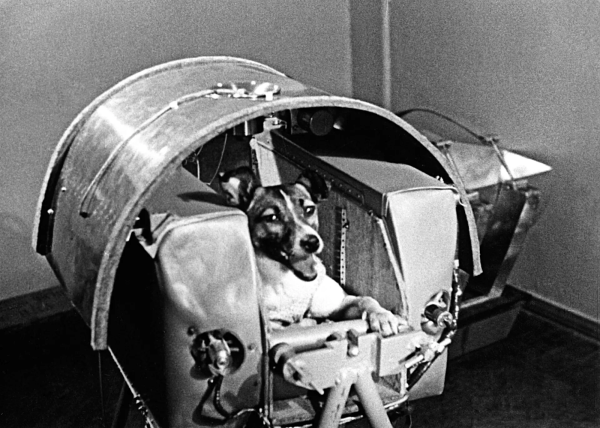
Laika sits in a test capsule a few days before her Sputnik II mission (The New Yorker, sourced from Alamy).
November 9, 1989 – The Berlin Wall opens up after standing for 28 years, symbolizing the end of the Cold War.
After World War Two and the fall of Nazi Germany, Europe was left reeling. Most countries liberated by the Allies were given their old territory back, while those freed by the Soviet Union were either absorbed or occupied as Satellite States. But when it came to what used to be Nazi Germany, the two factions agreed to divide it between themselves. This resulted in a democratic, capitalist Germany under Allied control in the west, and a communist Germany in the east.
As you would expect, these two new countries didn’t get along with each other. A conflict of ideals caused tension between the two, so their occupying powers went to great lengths to keep them separate. The Soviet Union built the Berlin Wall through the joint-occupied capital city in 1961, keeping its citizens from entering the Allied zone. Because of the totalitarian leadership in the city, many East Berliners tried to defect to the West by ways of digging tunnels, swimming in canals, and, in one case, a hot air balloon.
After many campaigns by Allied leaders, the Soviet Union tore down the Berlin Wall on November 9, 1989. Berlin families who were separated by the wall were finally reunited after 28 years. This event is considered a symbol of the collapse of the Soviet Union.
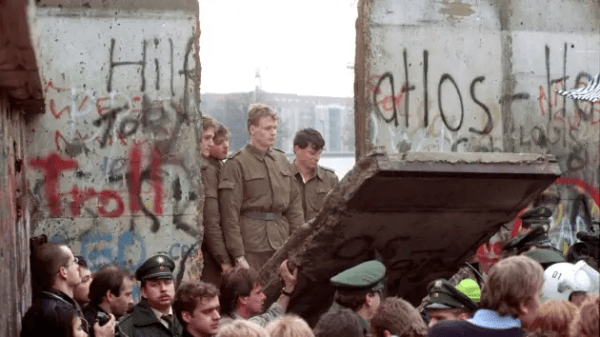
East German soldiers look on as demonstrators pull down a section of the Berlin Wall (AP News, Photo by Lionel Cironneau).
November 19, 1703 – The Man in the Iron Mask, the mysterious prisoner of Louis XIV in the Bastille prison in Paris, dies.
Although the Man in the Iron Mask is a famous fictional character in Alexandre Dumas’ “Dix Ans plus tard ou le Vicomte de Bragelonne” (Translated to English under the title “The Man in the Iron Mask”), he was a real prisoner of King Louis XIV and one of France’s most puzzling mysteries. To this day, the prisoner’s identity remains unknown due to the mask he wore throughout his detainment. Some said that he was an English nobleman— others theorized that he was Louis de Bourbon, the son of King Louis XIV and one of his mistresses. The French philosopher Voltaire popularized the idea that he was Louis XIV’s older brother, or even his secret twin. Despite all these theories, no one knows for sure who this famous prisoner was.
Strangely enough, the Man in the Iron Mask didn’t actually wear an iron mask— his face covering was made of black velvet or velours. The reason he wore the mask was also unknown; legend has it that he was forced to wear it to hide his identity and that two men were always on standby to kill him if he ever took it off. No one knows the reason for his imprisonment, either, except for his vague epithet of “political prisoner”.
Even though the Man in the Iron Mask’s identity remains unknown, he lives on in rumors, legends, and adaptations of his life and imprisonment.
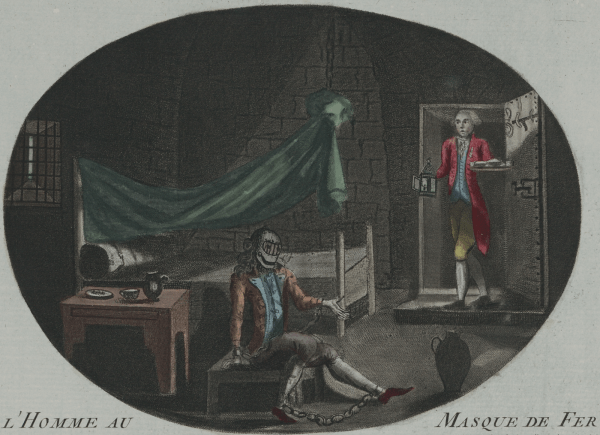
“L’Homme au Masque de Fer” or “The Man in the Iron Mask” Etching (1789, Artist Unknown).
Sources on:
 The Bishop Kelly Newspaper