
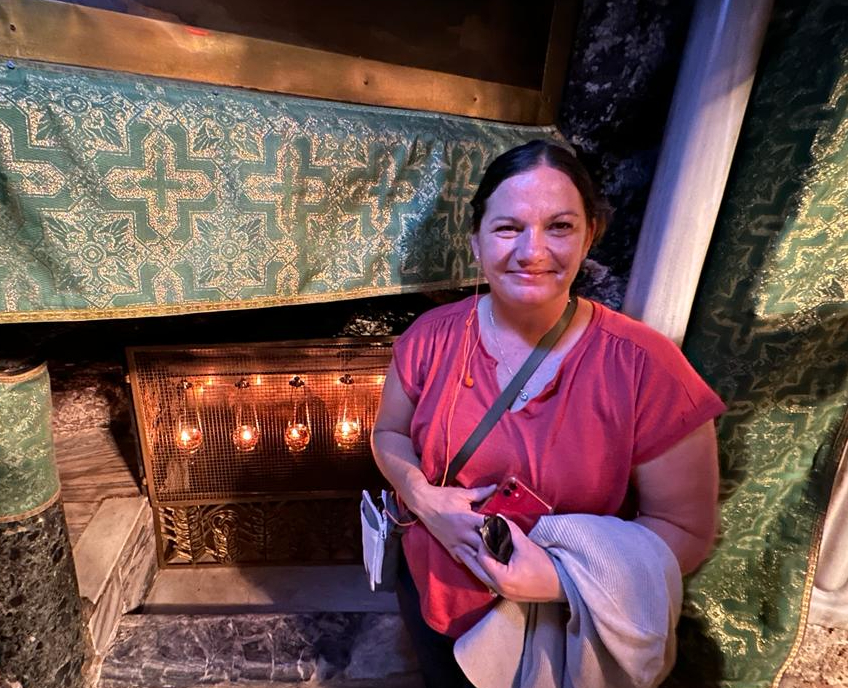
Mrs. Stroschein standing next to the Manger in Bethlehem.
As the Israeli-Palestinian conflict continues to escalate, BK students and staff are grateful to have Mrs. Stroschein and Mrs. Bieter safely back in Idaho. Their visit to the Holy Land along with a group of other pilgrims was unfortunately cut short due to the ongoing war between Hamas and Israel, nonetheless, they feel that the experience was very profound. Let’s focus on the lighter parts of the trip.
The group first flew to Tel Aviv, Israel. Mrs. Stroschein commented that jet lag wasn’t too bad for the first part of the trip because she was so excited for what was to come. Some of the many places they visited include the Basilica of the Annunciation, the Church of the Nativity, and the Church of the Holy Sepulchre.
Seeing these sites in person was a powerful experience. Mrs. Stroschein remarked, “I have this vision of what biblical land looks like, because I think of it in Jesus’ day…[but it was] much more technologically advanced and modern than I imagined.”

Mrs. Strochein and Mrs. Bieter (middle back row) with their pilgrimage group at the Sea of Galilee.
The Basilica of the Annunciation is an enormous church built over the site of what is believed to be the Virgin Mary’s house. There are first-century inscriptions about Mary in the walls of the house, leading scholars to believe that it is the place where she lived. In the middle of the cathedral stands the cave where Mary resided. Interestingly, there is also a baptistry where early Christians were brought into the church, very close to the site.
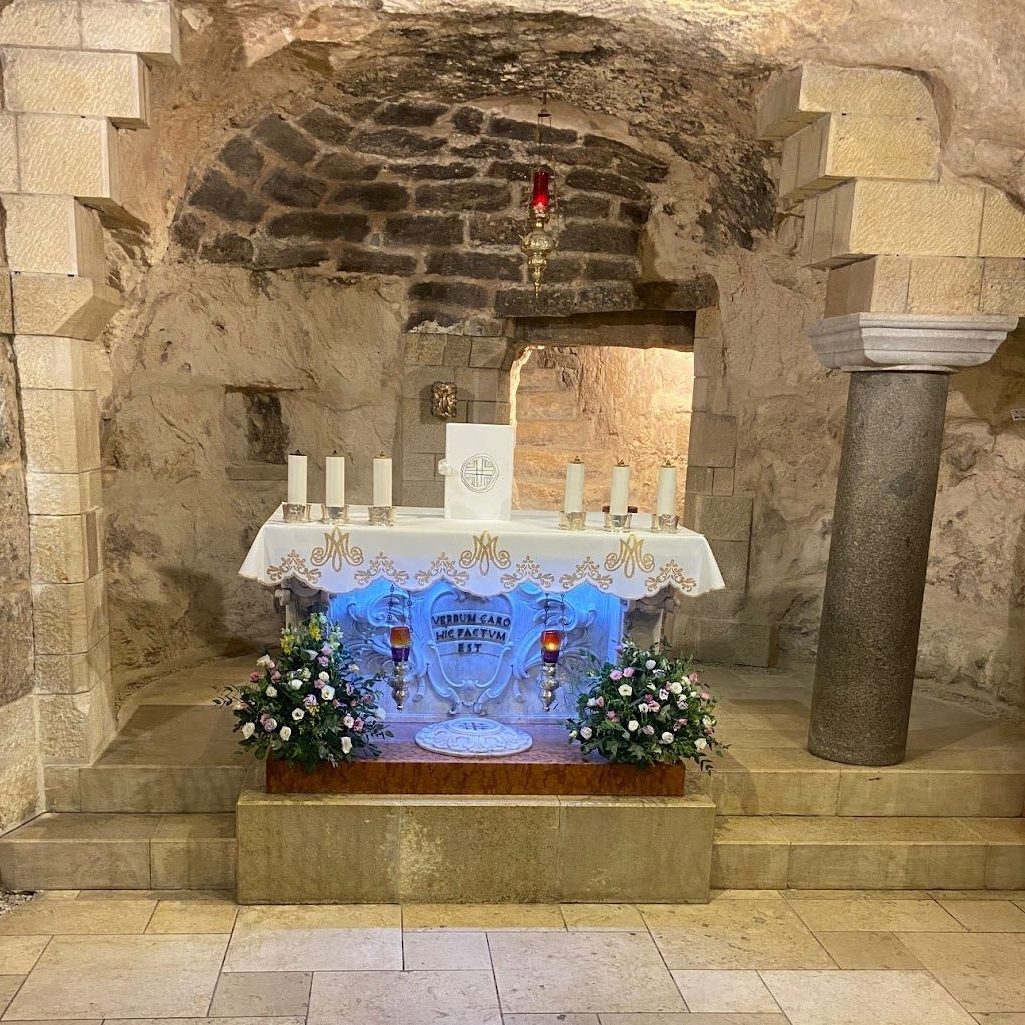
An altar inside the grotto at the Basilica of the Annunciation. Inscribed on the altar is the Latin phrase “Verbum caro HIC factum est” which means “the Word was made flesh HERE.”
The location of the Nativity is also a cave. Many people in Jesus’ time built their dwellings (in this case, a barn) in caves that provided natural shelter. The exact spot has been marked out with a star where Jesus was believed to have been born. According to Mrs. Stroschein, pilgrims were allowed to stoop down to the star and touch it with their hands.
The sites of Jesus’ death and His resurrection are very close in distance, so the Church of the Holy Sepulchre was built to cover both places. The place of Jesus’ tomb, as well as the stone that was under His Cross, both reside within this church. There is usually a very long line to go into the tomb, but due to the conflict, Mrs. Stroschein and the others only had to wait an hour. They were allowed ten seconds in the tomb, although the actual tomb is in a secret tunnel about a meter and a half below the accessible spot.

Entrance to The Church of the Holy Sepulchre.
The outbreak of fighting in the Holy Land made a drastic change in the schedule of the trip, which meant they did not get to walk the Way of the Cross, or see the place of the Visitation, the Dead Sea, and the Holocaust Museum. Many of the flights coming in and going out of Israel were suspended after the initial attacks, leaving many people stranded. Mrs. Stroschein says that her tour guide, being familiar with this kind of situation, told the group, “We’re just going to keep touring.”
However, the conflict was still close enough to be felt and seen. As Mrs. Stroschein narrated, “One time we were sitting on the patio [in our hotel], and the alarms went off, which means a missile strike was coming. We had to huddle in the corridor, away from the windows. As we went in, we saw one of the rockets going to Southeast Jerusalem. It went very fast, but didn’t cause a ton of damage.” She continued, “You could feel the cultural tension through interactions…with Jews, Palestinians, Christians. You could feel tensions between people just through conversations. Also, my guide was Palestinian Catholic, and being able to hear his story was a different take on the conflict. Hamas is in control of the area, but not all Palestinians are Muslim or support Hamas.” There was also tension anytime her group went through a checkpoint between areas; for instance, armed guards checked the tour bus.
Eventually, the group drove to Jordan, where they took a flight to Qatar, then home to Boise. Mrs. Stroschein commented that having to escape the area “helped me ponder, like when Mary, Joseph, and Jesus had to flee to Egypt when Herod was coming after him.”
As powerful as it was to be in the land where Jesus walked, Mrs. Stroschein testified that she “can encounter God just as intensely in Idaho. It’s the same Holy Spirit.”
According to the Catholic News Agency, Pope Francis has called for a day of fasting and prayer on Friday, October 27, for an end to the war. We are all encouraged to participate.
Photo Credit: Mrs. Stroschein.
 The Bishop Kelly Newspaper