
We’re halfway through the month of October, and we’ve already passed the anniversaries of several notable historical events. Here’s a recap of those significant dates, and some more events that occurred later in this month!
October 8, 1871 – The Great Fire of Chicago erupts
If you read last month’s edition, you know that a hot, dry summer combined with flammable building materials caused London to go up in flames back in 1666. Over two hundred years later, another famous fire broke out, this time in the United States. On the night of October 8, 1871, a fire began in a barn belonging to Patrick and Catherine O’Leary. Fires weren’t uncommon in Chicago; after all, candles and lanterns were the primary source of lighting at the time. This fire quickly grew out of control, however, and spread northeast to the city’s center.
Though it burned for less time than the fire of London, the Great Chicago Fire claimed more lives and destroyed more property. An estimated 300 people perished in the blaze, and caused over 200 million dollars in damage. Crime ran rampant among the newly homeless, and martial law was established for several weeks afterward to keep the city under control.
To this day, no one knows exactly what started the Great Fire. The enduring theory is that Mrs. O’Leary, the owner of the barn, left a lantern unattended, which was kicked over by her cow. She never admitted to this though, and there’s no proof that this is truly what happened. So why did the idea catch on so quickly? Well, Mrs. O’Leary and her husband were Irish, and anti-Irish sentiment ran rampant in America at the time. So even if they weren’t at fault, it was easy for Chicagoans to pin blame on the couple. A song about the Great Fire is still sung today by many Girl Scouts:
“Late last night when we were all in bed,
Mrs. O’Leary hung a lantern in the shed
And when the cow kicked it over, she winked her eye and said
‘It’s gonna be a hot time in the Old Town tonight’.”

The view of the Great Chicago Fire from the Randolph Street Bridge, depicted in a Currier and Ives lithograph (Chicago Historical Society).
October 14, 1912 – Former President Theodore Roosevelt was shot while campaigning in Milwaukee, but insisted on making his speech before being taken to the hospital.
At around 8pm, President Theodore Roosevelt left the Gilpatrick Hotel in order to give a campaign speech in the Milwaukee Auditorium. Before he could get into his car, however, a man in the crowd pulled out a revolver and shot the president. When the would-be assassin was turned over to the police, Roosevelt’s doctor advised that he go to the hospital, but the President insisted that he still give the campaign speech. His driver gave in and got him to the event on time.
The bullet would have taken a direct path to his heart, but luckily Roosevelt’s overcoat, glasses case, and the fifty-page manuscript to his speech slowed the bullet enough that it only became lodged in his chest. Despite his wound, the president still gave a 90-minute speech, telling the crowd, “I give my word, I do not care a rap about being shot.” He made a full recovery in two weeks.

A copy of Roosevelt’s speech which was in his pocket when he was shot (photo sourced from Wikipedia Commons).
October 21, 1805 – The Battle of Trafalgar took place between the British Royal Navy and the combined French and Spanish fleets.
The Napoleonic Wars were a series of wars between France, under control by Emperor Napoleon Bonaparte, and several other countries in Europe. As Austria and Prussia fought the French in continental Europe, Napoleon turned his sights on France’s rival, England. In the summer of 1805, Napoleon began to mobilize his naval fleets, led by Admiral Villeneuve.
Viscount Horatio Nelson, an Admiral in the British Navy, learned of the ships’ departure, and soon led his own fleet against the French. After several months of pursuit to the West Indies and back, Nelson’s and Villeneuve’s fleets finally met near the Cape of Trafalgar in Southwest Spain.
It seemed like Villeneuve, leading both a French and Spanish fleet, had the upper hand in this battle. Nelson, however, spent several months beforehand concocting a strategy to beat the enemy. He split his fleet into two columns and sailed directly toward Villenueve’s position. This allowed the British to break the enemy’s formation and get an edge on the French.
The battle raged for nearly six hours, and the British emerged victorious. In the end, 449 British and 4408 French and Spanish fatalities were sustained. The British took around 20,000 prisoners after the battle. Admiral Nelson was shot aboard his fleet’s flagship, the HMS Victory, and died not long after the fighting ended.
The Battle of Trafalgar is one of the most famous naval battles in history; today, the British still tell the story of Admiral Horatio Nelson and his heroic plan to stop Napoleon.

“The Battle of Trafalgar” painted by William Clarkson Stanfield.
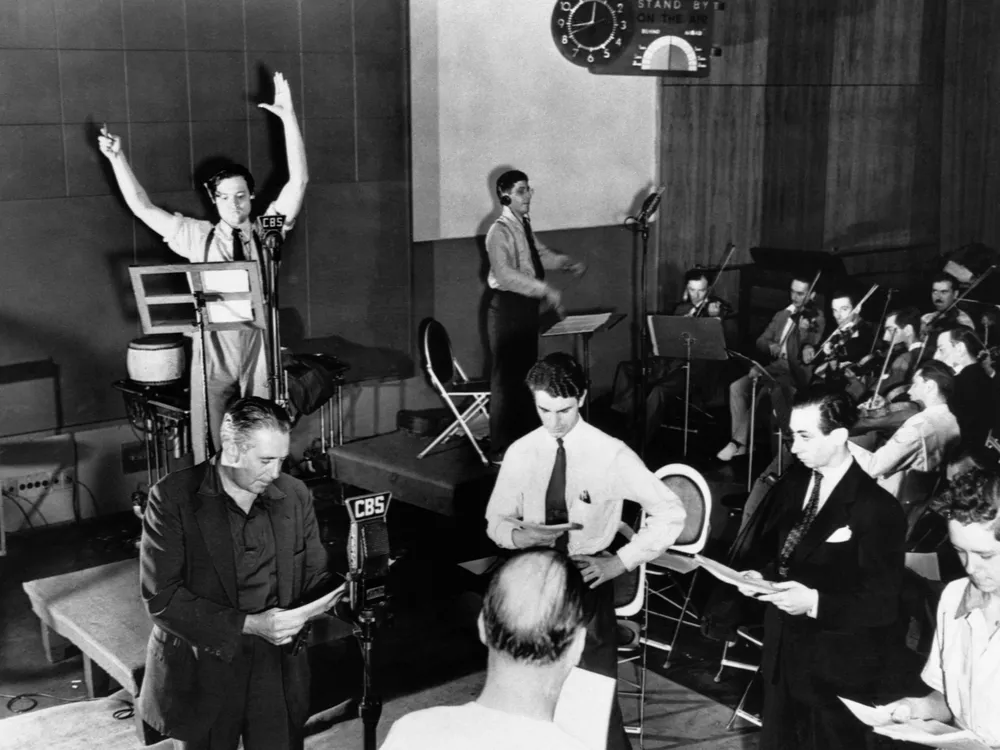
October 30, 1938 – The famed War of the Worlds radio broadcast panics millions of Americans.
On Halloween morning, 1938, the United States was coming down from a massive nationwide panic; the night before, Orson Welles and the Mercury Theater on Air broadcasted a radio adaptation of H.G. Wells’ novel War of the Worlds. Welles wanted the radio play to be as realistic as possible, which caused many listeners to believe that the events depicted on the air were real.
Welles, the co-owner of the Mercury Theater on Air, wanted to produce a novel adaptation told through news bulletins; the writing team soon settled on H.G. Wells’ War of the Worlds, which tells the story of a Martian invasion of Earth. The show’s writing team scrambled to produce a radio play out of a fairly ridiculous concept that would be taken seriously. Eventually, they scraped together a production that, while somewhat realistic, none of the producers thought would be taken as genuine.
Welles, however, made changes a few hours before the play was to be aired. These alterations made the play so realistic that listeners who tuned in after the start of the broadcast thought the news bulletins were real. This caused a mass panic as people fled cities, hysterically called news stations, and, in a few cases, took their own lives.
After the fact, Welles denied that he intended to deceive the public on the authenticity of the play, however in later years he hinted at the contrary. While in some instances this mass hysteria resulted in tragedy, in hindsight it’s pretty funny that a single broadcast caused this whole debacle. I highly recommend that you check the attached link on this play— it’s a fascinating and hilarious read!

Orson Welles (arms raised) rehearses War of the Worlds with the Mercury Theater on Air. (Smithsonian Magazine).
Sources on:
 The Bishop Kelly Newspaper