
(Catholic Saints Medals)
Saint Patrick’s Day got its name from, you guessed it, Saint Patrick. Honoring his death in the fifth century (believed to be March 17, 461), the religious holiday has been celebrated for more than 1,000 years. Historically, Lent has prohibited the consumption of meat on Fridays, but this holiday pushes the rule aside for one day, honoring the traditional meal of Irish bacon and cabbage. It’s truly a day to celebrate.
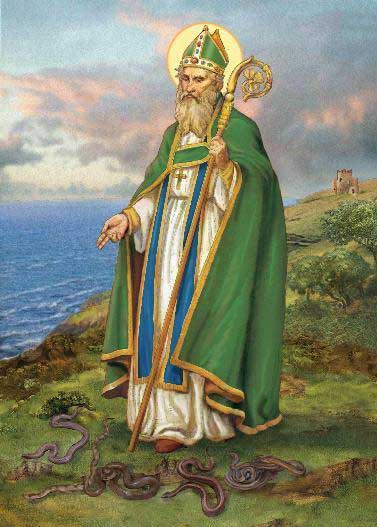
Saint Patrick is the patron saint of Ireland and its national apostle, and he is credited with introducing Christianity to the people of Ireland. Kidnapped at 16, he fled enslavement after six years and escaped to England, where he studied religion, later returning to Ireland to preach and educate the people of God’s love. The most notable teaching is his comparison of the Holy Trinity to the three leaves on a shamrock.
Surprisingly, however, there is still a lot of uncertainty surrounding the saint, and many theories have attempted to explain the life of this apparent stranger. One modern-day theory — accurately coined the “Two Patricks” theory — was first proposed by Thomas O’Rahilly around 1942. It was quite an unusual case where two men both named Patrick (one was commonly referred to as Palladius, while the other was called Patrick the Briton) led eerily similar lives. O’Rahilly explained that there were actually two men named Patrick; both were missionaries, Roman citizens, and sent to Ireland by popes, all in the same time frame.
So, who are we actually praying to every March 17th?
The answer, actually, doesn’t change. There may have been two Patricks, but Patrick the Briton was the one who was kidnapped at 16 and escaped to England. Patrick the Briton preached the word of God to the people of Ireland, and he’s the one we celebrate on his feast day, July 6th, and the anniversary of his death, March 17th.
Or so they say.
The theory itself is quite old, but the legend of Saint Patrick is even older. The original confusion between the two Patricks was due to nothing more than poor handwriting by an old medieval scribe that implied there was only one Patrick sent to Ireland. But the true story is still unknown today. It’s fun to play around in the past, but for now, the mystery will have to stay buried, hopefully answered sometime in the near future.
Regardless of which man it actually was, the spirit of Saint Patrick’s mission is still alive today, eagerly seen in many traditions throughout the world, ranging from spiritual customs in its homeland of Ireland to the traditional green-colored clothing commonly seen in the United States. Some have even suggested that there be another celebration for Saint Patrick on July 6th in honor of the saint’s feast day, but that debate has been tabled for another time. For now, it’s just March 17th.
There are other, odd traditions that are used to celebrate Saint Patrick’s Day. In 1962, workers began to use dye in the Chicago River to trace illegal sewage discharges, but they soon realized that it held a unique color. Since then, the river has been dyed green once a year to celebrate Ireland’s patron saint.
The other well known symbol is, of course, the leprechaun. For as famous as they are, there’s strangely no direct connection between them and Saint Patrick. The mischievous creatures do stem from Celtic folklore, but their pointy ears and buried treasure is, unfortunately, just a myth.
Whether it be Palladius or Patrick the Briton, July 6th or March 17th, nothing will take away the wonderful traditions of chocolate gold coins and fried foods on this special day in the middle of March. And, of course, celebrating a devoted saint.

Chicago River, dyed green for Saint Patrick’s Day — 2023
Photo courtesy of Mrs. (Alyssa) Allen
 The Bishop Kelly Newspaper